Sunday, August 2, 2020


Saturday, May 2, 2020
Monday, March 30, 2020
Wednesday, November 6, 2019
Saturday, October 19, 2019
The Eric Hjertstedt Sharp Daily Times
https://www.blogger.com/blogger.g?blogID=9193395495842546835#editor/target=post;postID=8404684291488569840
If you like The Tall Timber Telegraph you're going to LOVE High Country News



 For the second time in as many months, Enbridge Energy officials left
a Mellen, Wis. city council meeting Tuesday night, Oct. 1, with no
clear path forward.
For the second time in as many months, Enbridge Energy officials left
a Mellen, Wis. city council meeting Tuesday night, Oct. 1, with no
clear path forward.
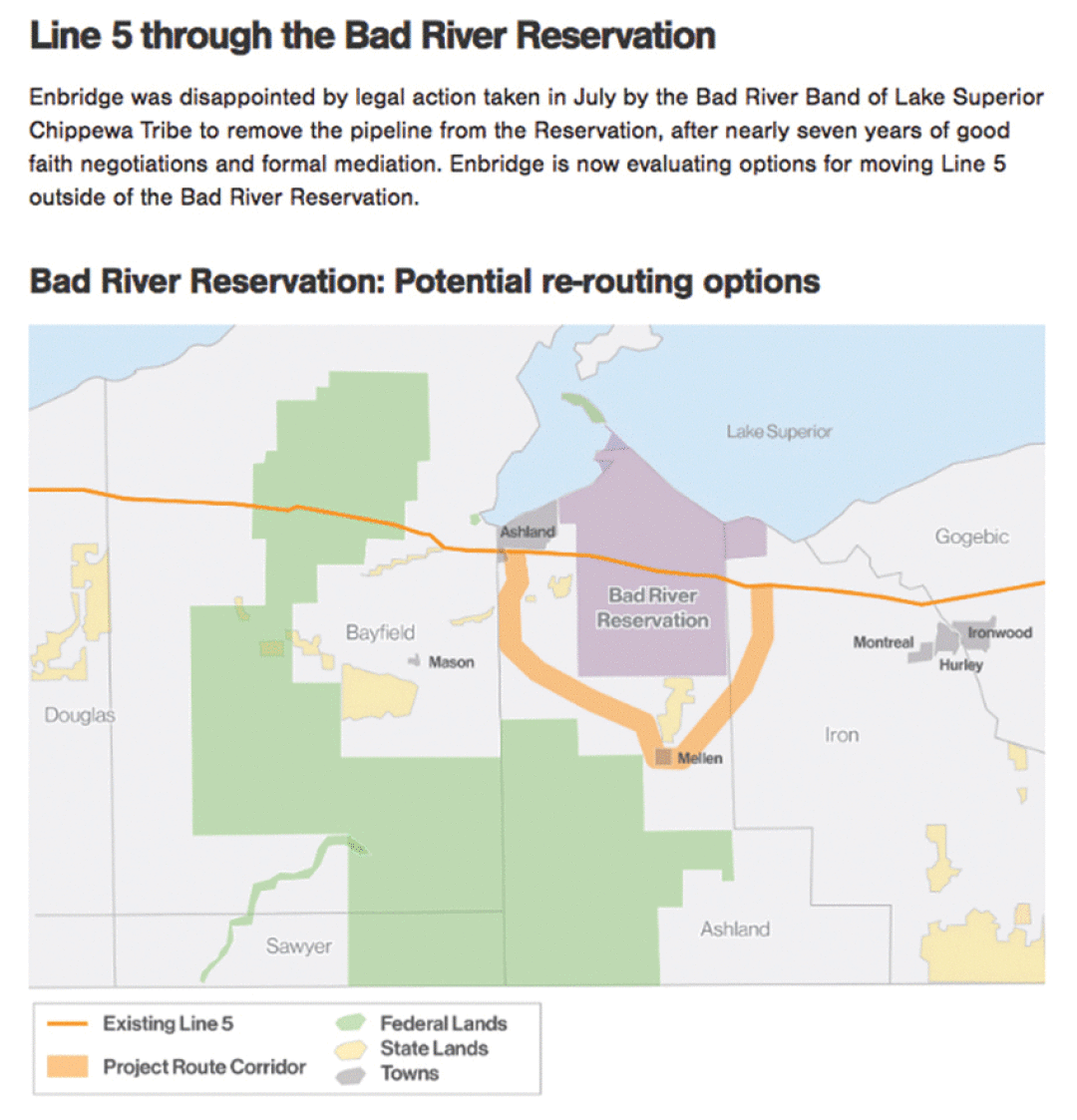
Enbridge seeks an alternative route to the east of Bad River for Line 5, an oil pipeline that runs from Ontario through Michigan to Superior, Wis. But the Mellen City Council failed to garner enough votes to allow a general, environmental and cultural survey of a city-owned lot in the town of Morse.
Several Enbridge officials attended the meeting, but left quickly after the vote.
Enbridge had asked city officials to consider a possible alternative route due to a federal lawsuit brought by the Bad River Band of Lake Superior Chippewa. The tribe wants the nearly 70 year-old pipeline removed from its land.
Last month, in a meeting attended by more than 55 people, held at the Legion Memorial Library in Mellen because of size constraints at City Hall, the council declined to act on Enbridge’s request.
Mayor Joe Barabe limited public input at Tuesday’s meeting, due to almost two months of public discussion around the controversial proposal. But he invited Dr. Susan Lee, a Mellen-area property owner from Madison, to speak briefly because she was not able to attend last month's meeting.
"This will make an imprint on the community," Lee said. "It is a moving target we're not ready for. This is obviously a bad idea. It will establish no jobs to local people and there will be no permanent jobs.
"No one here will gain, we will all lose. This is about property rights. This is about safety. We as a community do not have the infrastructure to support this," she added.
Jennifer Smith, Enbridge’s public affairs, communications and sustainability manager, said that Enbridge provides “a vital link to North American energy supplies. We are an experienced company with a long history in Wisconsin and we are committed to safe and reliable operations.”
Mayor Barabe cast the tie-breaking “no” vote, against allowing Enbridge to survey the lot.
Joining the mayor in voting no were councilors Joe Ricker, Jim Markee and Angela Nimmer. Voting yes, to allow Enbridge to conduct the survey, were Nathaniel Delegan, Jessica Jokinen and Barb Jusula.
Enbridge also conducted a public meeting Monday night at the Morse Town Hall, adjacent to Mellen, a population of slightly more than 700 citizens about five miles west of the popular attraction Copper Falls State Park. No official presentation was conducted at the Morse Hall meeting, but citizens were able to talk to Enbridge officials and ask questions or voice their concerns.
Bad River Chairman Mike Wiggins and other tribal officials held a much-publicized public meeting at the Northern Great Lakes Visitor Center near Ashland Tuesday night, the same time as the Mellen meeting, but no action was scheduled to come out of that meeting.
Line 5 passes under the Straits of Mackinac between Lake Huron and Lake Michigan. Numerous Michigan municipalities and counties have called for the line to be retired, citing environmental concerns.
If you like The Tall Timber Telegraph you're going to LOVE High Country News

Also from Eric Hjerstedt Sharp
for The Duluth Reader Weekly
News & Articles
Browse all content by date.
Screen capture from enbridge.com.
Enbridge seeks an alternative route to the east of Bad River for Line 5, an oil pipeline that runs from Ontario through Michigan to Superior, Wis. But the Mellen City Council failed to garner enough votes to allow a general, environmental and cultural survey of a city-owned lot in the town of Morse.
Several Enbridge officials attended the meeting, but left quickly after the vote.
Enbridge had asked city officials to consider a possible alternative route due to a federal lawsuit brought by the Bad River Band of Lake Superior Chippewa. The tribe wants the nearly 70 year-old pipeline removed from its land.
Last month, in a meeting attended by more than 55 people, held at the Legion Memorial Library in Mellen because of size constraints at City Hall, the council declined to act on Enbridge’s request.
Mayor Joe Barabe limited public input at Tuesday’s meeting, due to almost two months of public discussion around the controversial proposal. But he invited Dr. Susan Lee, a Mellen-area property owner from Madison, to speak briefly because she was not able to attend last month's meeting.
"This will make an imprint on the community," Lee said. "It is a moving target we're not ready for. This is obviously a bad idea. It will establish no jobs to local people and there will be no permanent jobs.
"No one here will gain, we will all lose. This is about property rights. This is about safety. We as a community do not have the infrastructure to support this," she added.
Jennifer Smith, Enbridge’s public affairs, communications and sustainability manager, said that Enbridge provides “a vital link to North American energy supplies. We are an experienced company with a long history in Wisconsin and we are committed to safe and reliable operations.”
Mayor Barabe cast the tie-breaking “no” vote, against allowing Enbridge to survey the lot.
Joining the mayor in voting no were councilors Joe Ricker, Jim Markee and Angela Nimmer. Voting yes, to allow Enbridge to conduct the survey, were Nathaniel Delegan, Jessica Jokinen and Barb Jusula.
Enbridge also conducted a public meeting Monday night at the Morse Town Hall, adjacent to Mellen, a population of slightly more than 700 citizens about five miles west of the popular attraction Copper Falls State Park. No official presentation was conducted at the Morse Hall meeting, but citizens were able to talk to Enbridge officials and ask questions or voice their concerns.
Bad River Chairman Mike Wiggins and other tribal officials held a much-publicized public meeting at the Northern Great Lakes Visitor Center near Ashland Tuesday night, the same time as the Mellen meeting, but no action was scheduled to come out of that meeting.
Line 5 passes under the Straits of Mackinac between Lake Huron and Lake Michigan. Numerous Michigan municipalities and counties have called for the line to be retired, citing environmental concerns.
 |
So John, what jobs does this create in the long term? Help me understand.
|
|
|
Hey
North of hwy 8, you ever wonder why modern civilization ends "North of
highway 8"? Its because of misinformed, uneducated, ignorant, small
minded folks like you.
|
|
|
Lashing out seems ignorant and small minded. You didn't answer the question.
|

|
Follow us on Facebook |
Is there a dollar value on Bay City Creek?
Of course not! Nor on any stream, lake or ocean. Nature is priceless.
http://www.greens.org/s-r/09/09-19.html
Alert! The addresses below may not be in use. Remember, this was 1996. Take to bring back the VISION again!
Synthesis/Regeneration home page | S/R 9 Contents
http://www.greens.org/s-r/09/09-19.html
Alert! The addresses below may not be in use. Remember, this was 1996. Take to bring back the VISION again!
The 7th Generation Amendment
by Walt Bresette, Lake Superior Greens, 7th Generation Committee
State and national legislatures are gutting environmental laws in a misguided effort to in response to the populist "wise use" movement and their corporate backers. The momentum is strong as the political pendulum swings against the earth.
The movement focuses on market value of private property, arguing that environmental laws are unfairly devaluing private property. A too narrow, yet effective, campaign in today's political atmosphere.
Once a fringe group, the "wise use" folks are now one of the new darlings of Congress. While some want private property owners to be compensated, others seek to remove any environmental law or regulation over private property.
Fortunately, the 5th Amendment to the US Constitution provides for some compensation. However, if the private property movement, fueled by corporate interests, have found safe haven, who is defending common property—that which provides the basis of life for all of us?
Where in the Constitution is air and water and ecosystems protected? We have an obligation to act, and our great grandchildren have a right to inherit our wealth, which certainly means more than a balanced budget.
In this rush to shore up private property rights, we are throwing out the baby with the bathwater. The short term solution for some creates an even greater and long term problem for us all. A fairer solution is to protect all property.
The taking of common property through abuse of private property use should be as illegal as the opposite.
Currently, common property-that, which by its nature, cannot be owned by an individual-is without protection. Yet, preservation of common property, such as air and water, are essential to all other rights.
Indeed, past environmental laws have had ambiguous constitutional authority; they were more common sense or common law. Some argue they are all reactionary, albeit necessary for the common good.
As effluents went beyond the fence line or smokestack or factory door, neighbors complained and rules and laws were promulgated. Necessary, but reactionary nonetheless. Today, when pitted against the clearer 5th Amendment protections, these laws and their protections are now endangered. Yet, the effluents continue and without regulation will increase, with very real impacts on health and habitat.
The challenge is to protect both, rather than getting rid of one at the expense of the other. In light of the obvious partisan politics afoot, what's needed is Constitutional balance, not more reactionary debate.
By adding to the definition of property we also broaden the concept of "takings," the term used in the private property debate. Common sense tells us that common property exists, and is being undermined, and needs protection, just as private property has protection.
7th Generation Amendment — Draft LanguageThe rights of the people to use and enjoy air, water, sunlight, and other renewable resources determined by Congress to be common property, shall not be impaired, nor shall such use impair their availability for the future generations.
The taking of common property through abuse of private property use should be as illegal as the opposite. Therefore we propose a Constitutional remedy which can provide these dual protections.
In revisiting the Constitution, we found no protection for common property. But we did find a that which, when married with new language, will provide protections. The basis, we think, is in the Preamble.
The Preamble states that these constitutional rights belong not just to us alive today but also to the future: "We the People of the United States . . . secure the Blessings of Liberty to ourselves and our Posterity." (Emphasis added.)
This Posterity clause clearly states that our descendants are guaranteed these "Blessings of Liberty." And we must infer that while we may use them today, we have no right to expend or damage them so that they are not available for the future. Rights were legally guaranteed for future generations. This was not a typographical error nor was it a superfluous filler. We intend to enliven this clause in our effort to assure the needed protections.
Thus, as we seek common property protections, we do so not just for today, as a momentary reaction to those in power, but we become constitutionally obligated to be caretakers for generations to come.
This different vision will enable us to see the consequences of our actions differently. By protecting rights for ourselves and for posterity we provide for the baby while changing the bath water.
Iroquois Chief Oren Lyons, in an interview with Bill Moyers, said that Benjamin Franklin turned to the Iroquois among others in trying to shape a better form of government. Apparently he listened and included elements of Iroquois governance including the concept of posterity.
Franklin's posterity, found in the Preamble, was the Iroquois concept of providing for the 7th generation. Chief Lyons said that as the Iroquois leaders contemplate policy they must always factor in how today's decision will affect the 7th generation into the future.
By simply attempting reform with what is available today, we remain in a stagnated "jobs vs. environment" polarization. In these complex times we must be more creative, yes proactive, and indeed accommodate all of our interests and rights, especially those yet to come.
To that end we, the 7th Generation Committee, have developed draft language which we think overcomes this dilemma. We call it the 7th Generation Amendment to the US Constitution. It was initially called the Common Property Amendment.
Our goal is to have a national debate beginning on Earth Day 1996, to have a bill before Congress on Earth Day 1997, and to get the necessary state ratifications by Earth Day 2000.
We chose Earth Day 2000 because half of those involved are youth who will turn 18 (voting age) on or after Earth Day 2000. The only criteria we ask of their participation is that they promise to vote.
If we adults refuse to look out for the future, the children of Generation M—the Millennial Generation—will rightfully set aside. In seven generations we will all be gone.
If we can rob from the poor to give to the rich ostensibly to balance the budget to prevent an unfair future economic burden, then surely we can commit the rest of our lives so that these same Great grandchildren will have the opportunity to breathe and drink safely.
And we must always remember, water is always more precious than gold.
7th Generation Timeline/Activities
Earth Day 1996-Environmental Fair for Youth, Benefit Concert for all, Milwaukee, Wisconsin; March/rally at State Capital, Madison, Wisconsin; national kick-off campaign.The 7th Generation Committee will gladly send materials or visit your community regarding this campaign. And, of course, all donations are gladly accepted. For more information write the 7th Generation Committee, 1200 Ellis Avenue, Ashland, WI 54806; Committee members: Walt Bresette, 715/779-5071; Tom Busiahn, 715/682-3658; Jan Conley, 715/392-5782 or 218/726-1828; Robin Goree, 715/682-8848; Frank Koehn, 715/774-3333; Judy Pratt-Shelly, 715/779-3700.
Synthesis/Regeneration home page | S/R 9 Contents
Subscribe to:
Posts (Atom)

Comments